If you transfer $5,000 from your bank account to a vendor today, the transaction is pure data. It is instant, structured, and seamless. No human has to look at a piece of paper to make it happen.
But if you want to send that same vendor proof of insurance? You are likely emailing a PDF.
In 2024, while other financial sectors have moved to pure data streams (APIs), the commercial insurance industry is still largely running on "digital paper." To understand why, we have to look at the history of the industry’s most ubiquitous tool: the ACORD form.
The Chaos Before the Standard In the late 1960s, the insurance industry was drowning in paper—literally. Every carrier had its own unique applications, binders, and certificate forms. An agent trying to quote a risk with five different carriers had to fill out five completely different applications. It was inefficient, prone to error, and maddening.
In 1970, the Association for Cooperative Operations Research and Development (ACORD) was formed to solve this. Their mission was standardization. They succeeded brilliantly. They created a universal language for the industry: +1
- The ACORD 125 for Applicant Information.
- The ACORD 126 for General Liability.
- The ubiquitous ACORD 25 for Certificates.
For the first time, an agent could fill out one form and send it to multiple markets. It was a revolution in efficiency.
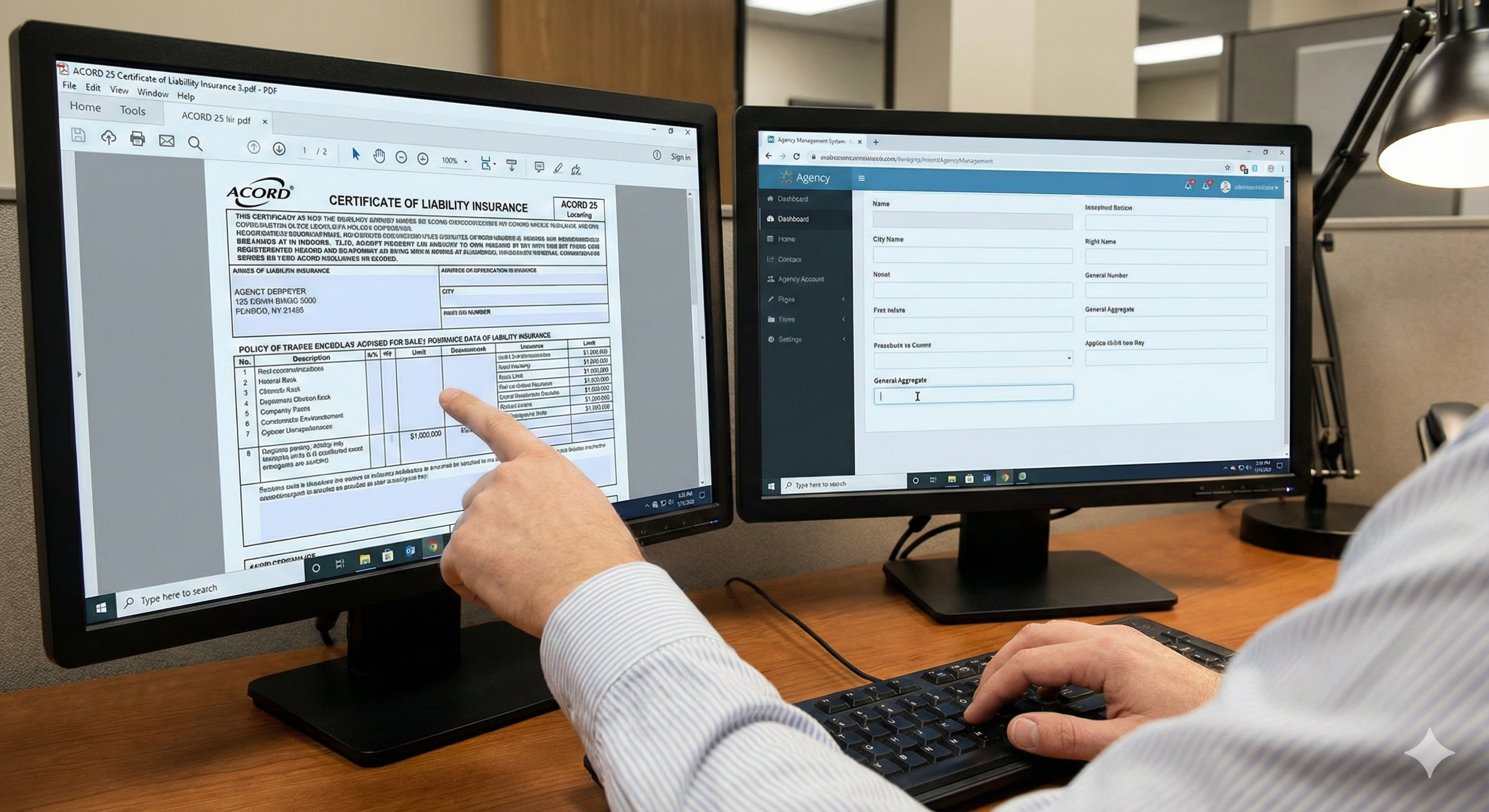
The "Unstructured Data" Trap However, as the world moved from filing cabinets to computers, the industry made a critical mistake. We digitized the image of the form, but not the data inside it.
When you save a document as a standard PDF, you are essentially taking a digital photograph of a piece of paper. To a human, it reads like English. To a computer, it is just a block of "unstructured data."
This is the PDF Problem.
Because the data is trapped inside these static documents ("unstructured"), it cannot flow easily from one system to another.
- The data sits in the insured's email body.
- A human has to read it and type it into the Agency Management System (AMS).
- The AMS generates a PDF.
- That PDF is emailed to a carrier or holder.
- The receiver opens the PDF and manually types that data into their system.
We have built a trillion-dollar industry on a workflow that relies on humans acting as "data routers," manually re-keying information from one static form to another.
Why "Forms" Are Hard to Kill Why hasn't this been fixed? Why don't we just transmit raw data like banks do?
The nuance of commercial risk is the barrier. Unlike a bank transaction (which is just a number), insurance data is complex. It involves exclusions, endorsements, varying limits, and descriptions of operations that don't fit neatly into a spreadsheet cell.
For decades, the ACORD PDF has remained the king because it is the only format flexible enough to carry this complexity in a way that humans can universally understand. It is the "lowest common denominator" of trust.
The Path Forward: Unlocking the Data The frustration agencies feel today isn't about the work itself; it's about the friction of the format. Agency owners know that their highly skilled staff shouldn't be spending hours transcribing data from an email into an ACORD 125.
The next evolution in our industry isn't about replacing the ACORD form—it’s likely here to stay as a visual standard. The evolution is about decoupling the data from the document.
New technologies (specifically AI and advanced Optical Character Recognition) are finally solving the "PDF Problem." We are entering a phase where software can "read" these unstructured forms as well as a human can, instantly turning that static PDF into fluid, structured data that can flow directly into an AMS or carrier portal.
We are finally finishing the job that ACORD started in 1970: moving from standardized paper to standardized data.